Systemic Disinformation: Cannabis and the Inherited Logic of Datafied Prohibition
Abstract
This paper argues that the legal cannabis sector provides one of the clearest demonstrations that disinformation can evolve into systemic risk. The twentieth-century propaganda that framed cannabis as dangerous did not disappear with legalization—it was absorbed into the infrastructures that now govern visibility, legitimacy, and value. Through platform moderation, brand-safety classifiers, compliance software, laboratory standards, and financial risk models, inherited bias circulates as code. The result is Datafied Prohibition: the migration of stigma into technology, where fear is automated and profitably sustained.
Drawing on the theories of Zuboff, Pasquale, Srnicek, and Harvey—alongside data from the 2025 Cannabis Media Transparency & Advertising Report and market analysis—the paper demonstrates how disinformation embedded in digital and regulatory systems becomes self-reinforcing. Advertising restrictions manufacture scarcity; compliance platforms monetize access; and volatility becomes a tradable asset. These mechanisms do not distort a stable system—they are the system.
Cannabis exposes disinformation not as a relic of the past but as a living architecture of control. It reveals how inherited falsehoods can destabilize entire domains of governance, economy, and knowledge—proving that when propaganda becomes infrastructure, it produces risk that no institution can diversify away.
Introduction
For nearly a century, cannabis has served as a laboratory for narrative control and the production of disinformation at scale. Tracing this history allows us to see how past propaganda becomes embedded in modern technological infrastructures. Cannabis thus provides a cautionary case of how disinformation adapts, mutates and ultimately becomes a form of systemic risk.
In the 1930’s the campaign against cannabis culminated in what is now referred to as “Reefer Madness”, one of the most notorious and effective disinformation efforts in U.S. history. Soon after the establishment of the Federal Bureau of Narcotics, its commissioner Harry Anslinger led a coordinated propaganda campaign in collaboration with Hearst-owned newspapers. This effort strategically fused racism, moral panic, and commercial interest. The message was chillingly effective: cannabis users were portrayed as prone to insanity, violence, and moral and sexual deviance. Cannabis posed a threat to white womanhood and the nation’s youth (Bonnie & Whitebread 1974, 100-109).
Through the alignment of political and commercial interests (rather than scientific consensus), the Marijuana Tax Act of 1937 cemented propaganda into federal law. The consequences were systemic. The Marijuana Tax Act did not simply criminalize a plant, it effectively criminalized entire communities. Cannabis prohibition disproportionately targeted Black and Mexican Americans, expanded law enforcement budgets and significantly contributed to the development of the prison industrial complex (Bonnie & Whitebread 1974; King & Mauer 2006; Gundai et el. 2022).
The effectiveness of the Reefer Madness propaganda campaign rested not only on deception, but on design. Its sensationalism established an emotional and cultural architecture that continues to structure virality today: vivid imagery, moral outrage, and repetition. Scholars of information disorder have demonstrated that emotionally charged, visually striking, and frequently repeated messages circulate independent of accuracy. Repetition produces cognitive ease, and familiarity then supersedes truth (Wardle & Derakhshan 2017, 40-47). The phrase “cannabis is dangerous” has been repeated so consistently that it now functions as what Shoshana Zuboff terms a behavioral cue—a conditioned reflex embedded into media environments and easily reactivated to elicit predictable responses (Zuboff 2019, 188).
Legalization has unfortunately not dismantled this reflex, it has simply digitized it. Although cannabis is now legal to sell in many jurisdictions, discussion of it remains algorithmically and economically constrained. Algorithms shaped by engagement optimization and historical bias routinely classify cannabis-related content as risky or illicit (Banchio 2024, Noble 2018, O’Neil 2016). Educational material, patient advocacy, and reform speech are suppressed while fear-framed narratives circulate freely. As Zuboff’s theory of instrumentarian power suggests, these systems do not coerce through force, they shape and condition behavior through subtle, data-driven modulation (Zuboff 2019). Instead of correcting the wrongs of prohibition, the ideology is instead reinforced.
Advertising restrictions further extend prohibition’s logic into digital markets by making visibility scarce and costly. Only cannabis companies with substantial resources can consistently navigate these restriction, securing premium placements through trade publishers. Smaller or legacy operators are rendered effectively invisible. As Nick Srnicek argues, platforms present themselves as neutral intermediaries while actively structuring the conditions of participation (Srnicek 2017). In cannabis media, this structuring inherently privileges capitalized actors while marginalizing everyone else, shaping not only who is seen but what is permitted to be spoken.
This engineered scarcity becomes a central economic driver. Trade publishers, cannabis conferences, and specialized ad networks leverage this residual stigma to justify inflated CPMs and exclusivity pricing. Simultaneously, engagement metrics often reward alarm over accuracy (Wardle & Derakhshan 2017, 8). Stories emphasizing cannabis addiction, psychosis or “cannabis hyperemesis syndrome” outperform positive or reform oriented news. Both because of cognitive bias and because moderation systems do not actively suppress such content. The result is a feedback loop where fear is no longer a psychological artifact, it becomes a form of capital.
Financial markets convert this dynamic into profitable market volatility. Limited public perception and an industry built on a foundation of “risk” allow for sentiment to move stocks more than fundamentals. Fear messaging is used to depress valuations and short bursts of well timed optimism briefly inflate them. Disinformation feeds both ends of this cycle and thus acquires quantifiable economic form. Perception itself becomes liquidity. The cannabis industry is essentially leveraged on it’s own manufactured uncertainty.
The continuation of cannabis disinformation and historical prohibition into current digital form constitutes what this paper defines as Datafied Prohibition. Prohibition’s ideology and control mechanisms have migrated into technological, regulatory, and market systems. Through platform governance, compliance frameworks, and media economics, the visibility and legitimacy of cannabis remains tightly controlled and highly manufactured. Within this configuration, disinformation is no longer an aberration. It becomes an organizing principle. This paper therefore argues that the current cannabis market exhibits systemic informational risk, in which disinformation has become so deeply embedded in technological infrastructures that it generates instability across media, regulatory, and financial domains.
To substantiate this argument, the research draws on the theoretical works of Shoshana Zuboff, David Harvey and Frank Pasquale, integrating their analysis of surveillance capitalism, dispossession by accumulation, and informational asymmetry. It also integrates stock market analysis, media-economic data and historical record to show how past disinformation becomes formational today and how this translates into measurable distortions across numerous systems. These findings are also contextualized through two decades of cannabis advocacy and participant observation.
Cannabis offers a rare empirical lens through which to observe how a century-old falsehood integrates into new technologies. It demonstrates how disinformation can become so inherent and widespread that distortion itself becomes a condition of stability.
1. Disinformation and Dispossession
Cannabis exposes disinformation not as a relic of the past, but as a live, evolving contagion. From criminalization to today’s compliance, the same foundational falsehood continues to govern legality, research, access and visibility. While it is widely acknowledged that the claim “cannabis is dangerous” emerged from racialized propaganda rather than scientific method (Bonnie & Whitebread 1974), this premise still underwrites the policies, platforms, and economic models that structure the cannabis industry today. The result is a landscape in which communities continue to face arrest, surveillance, and exclusion while the plant simultaneously generates substantial corporate profits (Gunadi et al. 2022). Cannabis offers a rare case in which historical propaganda doesn't just endure, but is actively utilized to justify corporate capture.
1.1. From Propaganda to Policy
Reefer Madness demonstrated how fear, when amplified at scale, can be converted into both political legitimacy and economic opportunity. The narratives of this propaganda were never officially retracted, instead they were rebranded. Today’s public discourse continues to revolve around “risk”, “safety”, and “harm reduction”, even in states where cannabis is legally being sold. This risk framing is not neutral. It sustains high regulatory barriers and compliance costs around an estimated $30 billion dollar emerging market (Grand Market Research 2024). In this configuration, the belief in cannabis as inherently dangerous generates the circumstances under which corporate capture becomes structurally advantageous.
Cannabis remains federally scheduled alongside heroin and methamphetamine, defined as having “no accepted medical use”. Yet legalization proceeds precisely because its medical benefits are undeniable. The Schedule I classification itself therefore functions less as a scientific designation than as a residue of disinformation. Because the original myth endures and remains profitable, the remedy for this remains deferred.
1.2. Reefer Madness Rebranded
As legalization gained traction in the 2010s, a new wave of “danger” narratives emerged to replace the collapsing moral panic:
- 1. THC potency was reaching dangerous levels
- 2. Cannabis causes Cannabis Hyperemesis Syndrome (CHS)
- 3. Cannabis is addictive
- 4. Cannabis causes psychosis
At first glance, these claims appear empirical. Under scrutiny, however, they collapse into contradiction. THC testing lacks standardized baselines (California Department of Cannabis Control 2022), and recent investigations have shown that many labs routinely inflate potency to meet market expectations (Bidwell et al. 2025, Smith-Gonnell & White 2025). CHS—framed as cannabis-induced cyclical vomiting—has no biomarker, no confirmed causal mechanism, and is diagnosed primarily by exclusion and assumption (Goyal et al. 2024, California Department of Public Health 2023). Research on “cannabis addiction” often relies on criteria so expansive that temporary restlessness or irritability qualify as withdrawal (Hall et al. 2021). And the psychosis narrative, recycled for nearly a century, still lacks causal evidence or population-level correlation; global psychosis rates have remained relatively stable despite the exponential rise in cannabis consumption (Chung et al. 2023). Many studies further conflate natural cannabis with synthetic cannabinoids such as Spice or K2—chemically and pharmacologically distinct substances—distorting the evidentiary record (Wilkinson et al. 2014).
What these narratives share is a structural logic rather than a scientific one. Each isolates a single fear (potency, vomiting, addiction, psychosis), treats it as self-contained, and avoids cross-confirmation. For example, if heavy cannabis use caused psychosis, CHS studies—which focus on heavy-use populations—should show psychosis incidence. They do not (Goyal et al. 2024, Cue et al. 2023). If cannabis caused clinically meaningful addiction, CHS cases would show withdrawal difficulty, yet the widely reported “resolution” is simply cessation and symptom relief through heat exposure (Cue et al. 2023, Chang et al. 2009). These contradictions are rarely examined. Meanwhile, data demonstrating cannabis’s antiemetic, analgesic, and substance-use recovery applications is routinely framed as controversial.
Because these narratives resemble the prohibitionist data that early content-moderation and risk-classification algorithms were trained on, they circulate with minimal resistance. Meanwhile corrective or patient-centered information around cannabis is disproportionately labeled “sensitive” or “risky”. The techniques of cannabis propaganda have not changed, only their delivery system. Divide, omit, exploit uncertainty, manufacture authority, cherry-pick evidence, and conflate correlation with causation. Through repetition and algorithmic amplification, fear becomes familiarity and familiarity becomes belief. The form of cannabis disinformation may have evolved, but its function remains constant: sustaining a profitable state of perceived danger.
1.3. From Criminalization to Corporate Capture
These narratives do not merely distort knowledge, they determine who is allowed to participate. Every recycled claim of danger justifies additional regulation, surveillance, and oversight. Each one introducing new barriers to entry. Sustaining the illusion of cannabis as inherently risky allows exclusion itself to function as a precondition for profit.
California’s Proposition 64 demonstrates this dynamic clearly. Marketed as equity reform, its passage was followed by an amendment permitting corporations to accumulate an unrestricted number of “micro-licenses” (McGreevy 2022). Meanwhile, legacy cultivators and community-rooted dispensary operators navigated an increasingly burdensome regulatory terrain: tamper-proof packaging, expensive compliance software, zoning conflicts, and escalating operational costs with zero tax breaks. The outcome was not surprising. Thousands of small businesses shuttered. Today in California, inactive cannabis licenses outnumber active ones, and over a thousand smaller licenses have consolidated into corporate holdings (MJBizDaily Staff 2025). This is what David Harvey terms accumulation by dispossession. Wealth is produced not through creation, but through enclosure—where crisis and fear devalue local assets and enable their acquisition at minimal cost (Harvey 2004).
This logic is not new. While the Marijuana Tax Act did not include explicit civil forfeiture provisions, it established the legal pathway by which cannabis was made grounds for dispossession. Because failure to obtain the required tax stamp constituted tax evasion, fines and federal liens enabled property seizure through existing tax enforcement mechanisms (Marijuana Tax Act of 1937). This pathway expanded significantly under the Controlled Substances Act (1970) which formalized asset forfeiture and continues to facilitate land and property seizure in cannabis-related enforcement today (Controlled Substances Act, 21 U.S.C. § 881 1970, U.S. Department of Justice 2023).
The fallacy of “cannabis as dangerous’ also allowed for the erasure and displacement of traditional cannabis knowledge—particularly in Black, Indigenous, and Latinx communities where the plant held longstanding medicinal, spiritual, and cultural significance. Prohibition did not merely restrict economic participation, it severed cultural authority and relationship to the plant itself. What had once been shared, communal knowledge was criminalized, delegitimized, and rendered invisible. That same knowledge has now re-entered the legal market as a commodified corporate resource—circulated through licensing systems, pharmaceutical patents, proprietary genetics libraries, and branded “expertise”.
1.4. Surveillance, Safety, and Structural Control
As Shoshana Zuboff observes, surveillance capitalism thrives on cycles of dispossession. Crises of safety or morality that legitimize new forms of monitoring and control (Zuboff 2019). Cannabis offers one of the clearest real-time examples of this process. Each renewed “public health scare,” whether centered on potency, psychosis, or CHS, justifies deeper enclosure: stricter regulations, greater dependence on compliance software, and expanded surveillance requirements. Cannabis has become one of the most heavily tracked commodities in modern commerce, monitored through seed-to-sale databases, track-and-trace systems, ID verification checkpoints, and point-of-sale analytics (California Department of Food and Agriculture 2019, Office of Cannabis Management 2025).
This extractive logic extends into financial and data infrastructures as well. Because cannabis remains federally illegal, banks classify cannabis revenue as “high-risk”, placing licensed businesses into Enhanced Due Diligence frameworks originally designed for terrorism, money laundering, and organized crime. Yet licensed cannabis operators are among the most heavily audited, documented and tax-verified businesses in the United States (ACAMS 2022). The risk is not empirical, it is inherited. And large financial institutions profit directly from this barrier, through exorbitant fees and low cost (cash) deposits (Joyce 2022).
The disinformation that framed cannabis as dangerous was first encoded into law, then into enforcement databases, and later into risk-classification models that shape both content moderation systems and financial compliance algorithms. The original falsehood has become a technical rule. There is little incentive to correct the rule because maintaining it is more profitable than dismantling it. The highly regulated and overtaxed legal cannabis industry cannot compete with an illicit market that has no such burdens (Marijuana Policy Project n.d., McGreevy 2022). In legal cannabis, exclusion, not cultivation has become the primary asset. The management of access to cannabis is now a more stable and lucrative business than cannabis itself (Harvey 2004, Srnicek 2016).
This reveals the core logic of Datafied Prohibition. Control did not disappear, it migrated into code, compliance, and classification. Through inherited bias and automated systems, disinformation became systemic. It persists not because it is legitimate, but because it is profitable. Without the narrative of “cannabis is dangerous,” exclusion could not be economically justified or enforced. In this sense, disinformation does not merely support governance. It becomes it.
2. Advertising Restrictions and the Architecture of Visibility
The advertising environment for legal cannabis continues to expose how disinformation becomes profitable. Drawing on data from the 2025 Cannabis Media Transparency & Advertising Report—including CPM analysis, media kit comparisons, and platform policy reviews—it reveals a market where visibility itself is scarce. Platform bans and “safety” rhetoric have created a marketplace where constraint defines value. In this case, visibility depends less on message quality than on the ability to absorb the cost of limitation. Those who can pay the price, benefit from it. Constraint becomes a competitive filter.
Within this Datafied Prohibition, fear generates limitation, limitation concentrates power, and concentration reinforces the narratives of fear that justified the limitation in the first place. In Nick Srnicek’s terms, this reflects the infrastructure of platform capitalism. Control is exercised not by dictating what can be said, but by determining what can be seen (Srnicek 2017).
2.1. A Constrained Marketplace
Despite widespread legalization, cannabis remains excluded from mainstream digital advertising. Meta and Google continue to classify cannabis as an illicit substance (Google Ads Policy 2025, Meta Advertising Standards 2025). TikTok enforces zero-tolerance content removal (TikTok Community Guidelines 2025), and YouTube demonetizes cannabis content under its “recreational drugs” policy (YouTube Policy 2025). Most out-of-home networks and programmatic advertising exchanges follow similar brand-safety restrictions. The result is a compressed media ecosystem centered around a narrow collection of trade publications and industry event organizers—MJBizDaily, Cannabis Business Times, Leafly, High Times, Ganjapreneur, and a limited number of regional expos.
With so few compliant outlets, cannabis brands must compete for the same limited audience through the same limited formats: banner placements, newsletter sponsorships, dedicated email blasts, and trade show appearances. Because this inventory is scarce, reasonably priced placements are purchased quickly. Marketers are pushed toward premium formats that promise visibility but consume disproportionate shares of their budgets. A single MJBizDaily dedicated email blast (~$6,000) can represent 15–30% of a small brand’s annual marketing spend (Marinaro 2025).
2.2. Why Automation Fails and how Scarcity Replaces Scale
In mainstream B2B advertising, publishers grow revenue through scale and automation: programmatic exchanges sell inventory automatically, data targeting expands audiences, and network integration lowers cost per impression. Cannabis publishers are largely excluded from this infrastructure. Major ad networks flag cannabis as a restricted category—even in legal states—blocking participation in automated marketplaces. State-by-state advertising rules require manual review for each campaign, while age-gating and payment-processor constraints further isolate cannabis outlets from the automated systems that drive efficiency in other industries (Interactive Advertising Bureau 2020).
As Safiya Noble demonstrates, algorithmic systems inherit the biases embedded in the data from which they are trained (Noble 2018). Cannabis advertising is a prime example of this principle. Cannabis continues to be algorithmically coded as a category of risk through the inherited bias of automated technologies. These restrictions cannot be explained solely by the plant’s federal Schedule I status either. Even in fully legal markets where cannabis is regulated, taxed, and tracked platforms continue to classify cannabis related content as “high-risk” and restrict advertising access. Cannabis thus becomes legal to sell, highly taxable, but still unspeakable.
The moral panic that once circulated through newspaper headlines now persists as automated “safety” logic in advertising software. Excluded from automation and scale, cannabis publishers operate within a manually brokered marketplace. Inventory remains fixed while demand concentrates among a small number of well-funded advertisers. Under these conditions, scarcity replaces scale as the primary revenue model.

2.3. Email and Events: Monetizing Limitation
With mainstream advertising channels effectively closed and social media marketing subject to unpredictable shadow bans and account removals, cannabis businesses have become disproportionately reliant on email marketing. Yet this channel is both inefficient and prohibitively expensive. A dedicated industry e-blast costs $6,000 to reach 97,000 subscribers. With an average open rate near 25%, this translates to more than $240 per 1,000 engaged readers. By comparison, mainstream B2B email rates typically range between $3 and $50 per 1,000 sends, depending on the audience specificity and targeting. Even when adjusted for engagement, cannabis CPMs remain several times higher (Marinaro 2025).
These costs reflect deficiency, not performance. Media kits of cannabis publishers lack transparent data and third-party verification, which makes ROI extremely difficult to substantiate. Because of the high failure rate of cannabis businesses, many subscriber lists include inactive accounts and shuttered businesses, reducing effective reach. Advertisers therefore pay not for precision targeting or proven engagement, but for the permission to speak at all. Within this bottleneck, the exclusivity of an email list becomes a form of leverage. Ownership of large email lists can be translated directly into authority, positioning list owners as gatekeepers of industry legitimacy.


Trade shows replicate this scarcity logic offline. Cannabis expos/events are the second most common marketing channel after email campaigns, yet they also cost several times more per qualified lead than comparable B2B events. Standard 10x10 booths at major U.S. cannabis expos average around $8,700—more than double the rate for a comparable booth at the New York Toy Fair. Which draws over 25,000 verified buyers and is well marketed through mainstream advertising channels. By contrast, only an estimated 30% of the leading cannabis expo’s roughly 30,000 attendees represent purchasing decision-makers. Because these events operate under the same advertising restrictions as the cannabis brands themselves, the audience remains insular (Marinaro 2025).
2.4.Influence as Inventory
As access to broad audiences remains structurally limited, cannabis publishers cannot sell reach. So they sell recognition instead. When scale is blocked, authority becomes the commodity. The most valuable offerings in cannabis media are therefore not static banner placements or traditional placements but credibility products: webinars, sponsored “thought leadership”, podcasts, and branded editorial features that blur the line between earned and paid media. These formats are priced as education rather than promotion, marketed through the language of trusted voice, expert insight, and regulatory alignment.
This dynamic operates essentially through credibility laundering. Cultural legitimacy that originates in patient networks, caregiver expertise, legacy growers, and community educators is translated into institutional legitimacy. In cannabis trade media, frequency of publication, platform visibility, and conference presence substitute for substantive knowledge. High-volume engagement (typically elicited through echo-chambers) becomes framed as a leadership signal. Repetition becomes authority. What is sold is not simply access to an audience, but the appearance that such access reflects earned expertise.
This shift can be further understood through Tiziana Terranova’s concept of free labor, which describes how cultural and community participation generates economic value without being recognized as such (Terranova 2000). In cannabis, the reputational trust built through years of patient advocacy, shared knowledge, and subcultural stewardship becomes monetizable inventory. What once functioned as social capital becomes commercial capital. And the economics reinforce this. Because cannabis publishers are prevented from scaling audience reach, revenue is generated by inflating the value of being seen. Comparable placements in other B2B sectors cost significantly less while reaching far larger audiences through traditional advertising. But in cannabis, where visibility itself is rationed, credibility becomes a premium asset.

For many trade publishers, this model is no longer supplemental. In the absence of diversified revenue streams such as subscriptions, research services, or programmatic inventory, credibility offerings have largely become the business model (Marinaro 2025). Influence becomes inventory. Legitimacy becomes a commodity. And the architecture of insufficiency is sustained not only through regulation and platform policy, but through the economic valorization of authority itself.
2.5. Structural Consequences of Pay-to-Play Visibility
The cumulative effect of the restricted advertising environment is a structurally pay-to-play system. During the early expansion years, Multi-State Operators (MSOs) set premium pricing norms by paying top rates for sponsored content, dedicated email blasts, conference booths, and naming-level sponsorships. Even after the market contraction of 2023, those rates did not decline—because the limitation that produced them remains in place.
Independent and legacy brands cannot absorb $200+ CPM email campaigns or $10,000+ conference packages while also navigating high compliance costs and regulatory fees. They also can’t write off such expenses on their taxes. Each campaign becomes a high-risk wager rather than a growth strategy. Meanwhile, well-capitalized firms are able to maintain continuous, repeated visibility across every major trade publisher. Because only the largest operators and compliance-oriented service vendors can afford consistent communication, the system disproportionately privileges those already advantaged by regulation.
Compliance complexity becomes a protective moat, not a neutral safeguard. For MSOs, heavy regulation suppresses competition. For ancillary vendors (licensing platforms, seed-to-sale tracking systems, compliance and regulatory consultancies) complexity itself becomes the product. Each new restriction expands their market position. This economic advantage is continuously reinforced by the platform architectures that govern visibility. The automated systems that inherited the bias of prohibition. Effectively, the firms most capable of paying for exposure are also those whose messaging is most consistently algorithmically favored.
The result is a zero-sum communicative environment in which the cost of being heard determines the boundaries of what can be said. Economic power becomes inseparable from informational power. The capacity to speak becomes the capacity to define the market. Christian Fuchs describes this as communicative inequality. Visibility follows capital, and exclusion follows structural constraint (Fuchs 2020). The cannabis advertising landscape unfortunately makes this principle measurable.
2.6. The Feedback Loop
Advertising limitation does more than distort marketing budgets, it shapes belief. When inventory is scarce, prices rise. When prices rise, only the largest and best-capitalized firms can afford sustained exposure. As visibility concentrates among those firms, the range of narratives in circulation narrows. This narrowing may present itself as an economic outcome rather than an ideological one, however the effect is functionally identical to ideological control. A smaller field of voices continually reaffirms cannabis as a high-risk category, which in turn justifies the advertising and platform restrictions that produce insufficiency. Here, fear and limitation do not merely coexist, they reproduce one another.
Frank Pasquale’s concept of the black-box society clarifies this dynamic. In systems where visibility is controlled, opacity is not incidental. It is the mechanism of power (Pasquale 2015). Cannabis advertising operates under opacity of price (CPMS vary widely with minimal verification), opacity of compliance (policies are selectively enforced and rarely transparent), and opacity of access (audiences are reachable only through walled-garden trade platforms rather than open networks). These forms of opacity protect incumbents and silence challengers. Those who can afford repeated exposure gain legitimacy through familiarity. Those who cannot are rendered essentially invisible, regardless of product quality, cultural relevance, or community trust.
What emerges is a profitable cycle of disinformation. The inherited stigma that frames cannabis as “risky” established the conditions that make advertising constrained in the first place. Scarcity then determines price. Price determines visibility. And visibility determine what is true. The market does not simply mirror public belief about cannabis, it actively produces it. Disinformation is no longer historical residue. It becomes the requirement for sustaining the industry’s current distribution of power.
3. Narrative Influence and Market Incentives
As established in the preceding section, advertising scarcity does more than distort marketing budgets—it reshapes the conditions of communication and the structure of belief. Because cannabis publishers rely almost entirely on advertising and event sponsorships rather than subscriptions pr institutional support, financial survival depends on serving those who can pay for ongoing visibility. This dynamic reflects the extent to which editorial agendas become aligned with advertiser priorities over time (McChesney 2015).
However, in cannabis, this alignment does not occur in a neutral media environment. It takes place within an informational landscape already dominated by prohibition-era stigma. The economic incentives of publishing therefore layer onto, and actively reinforce, the inherited narrative of cannabis as risk. What appears to be market response is, in practice, narrative reproduction.
3.1. How Business Models Shape Cannabis Media
Again, most major cannabis media outlets are heavily dependent on advertising and event revenue, rather than reader subscriptions or government funding. MJBizDaily (acquired by Emerald X in 2021 for approximately $120 million) derives the majority of its revenue from sponsorships, paid placements, and its flagship trade show, MJBizCon. Leafly’s SEC filings likewise show that more than 80% of their revenue comes from retailer listings, marketplace subscriptions, and digital advertising rather than audience payment. Ganjapreneur and Cannabis Business Times follow similar cannabis B2B media models, monetizing through display ads, branded content packages, webinars, email sponsorships, and event partnerships. In each case, media viability depends on advertisers, not readers (Marinaro 2025).
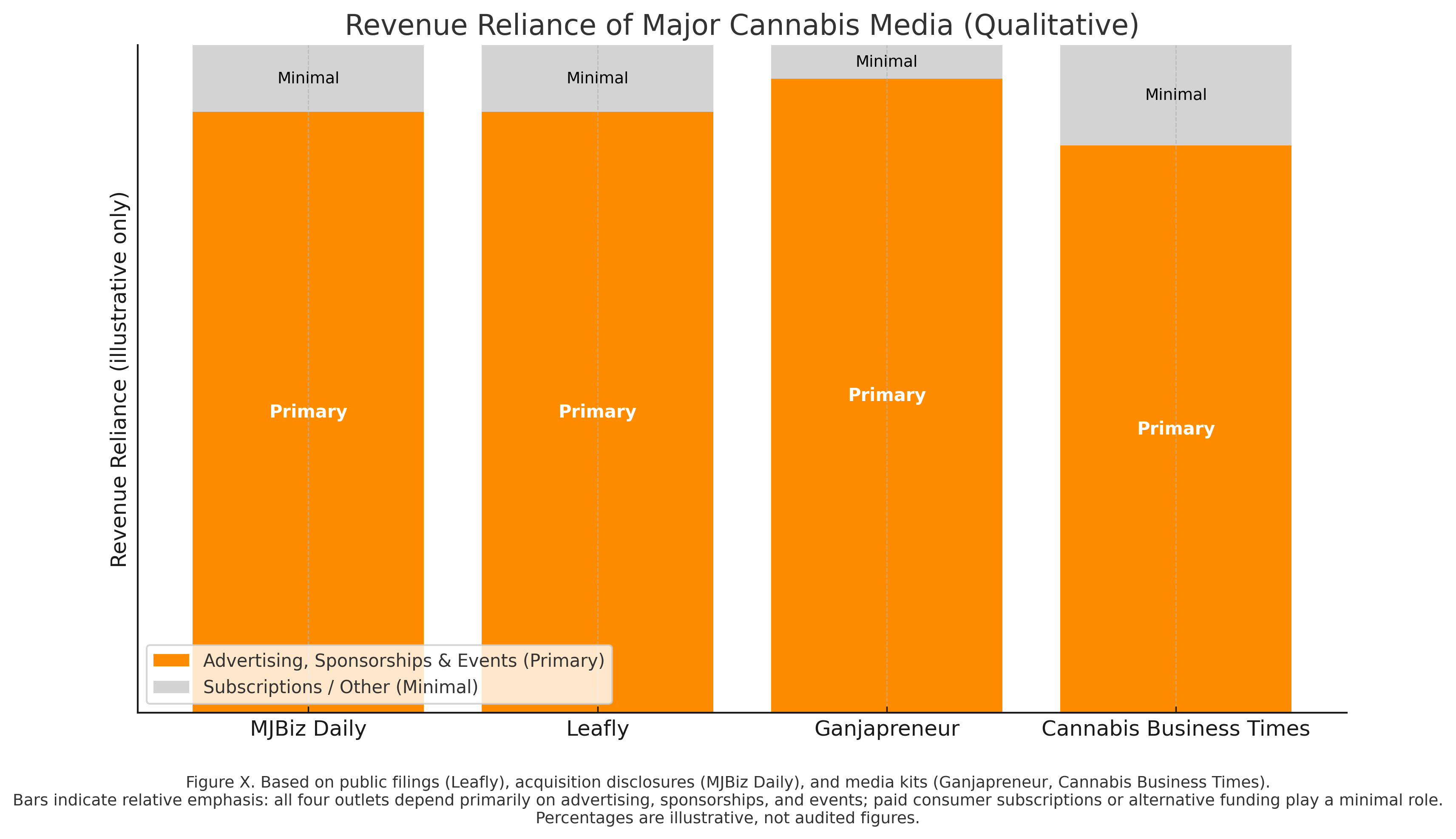
What these outlets describe as “subscriptions” or “memberships” are typically business-facing marketing products: directory placement, premium listings, SEO exposure packages, or branded editorial tiers. The “subscriber” in this model is not the audience but the advertiser. As a result, advertisers function as the economic gatekeepers of visibility.
3.2. The Production of Legitimacy
From the outset of legalization, many Multi-State Operators (MSOs) supported strict regulatory frameworks. Not in spite of their burden, but because they created competitive insulation. Leadership within these firms disproportionately came from pharmaceuticals, alcohol, finance, and other heavily regulated sectors, where compliance complexity is a known competitive advantage (Sacirbey 2021). Regulatory strictness functioned as a market design, a mechanism for determining who could participate and who could not. From 2018 to 2021, MSOs dominated trade advertising and conference sponsorships, effectively underwriting the major cannabis media ecosystem. When capital contracted after 2022 and MSO marketing budgets declined, pricing within trade media did not fall (Roberts 2024). Instead, publishers shifted revenue models upward toward higher-margin sponsorship tiers, expert columns, educational partnerships, and “thought-leadership” placements.
The advertisers who filled this gap were primarily ancillary compliance, licensing, data, and software vendors. Firms whose revenue depends on the preservation and expansion of regulatory complexity (MJBiz Daily Media Kit 2024). They did not simply replace MSOs as sponsors, they replaced them as the primary narrators of industry legitimacy. The prohibition-era claim that cannabis is dangerous did not disappear—it was translated into managerial language. The moral panic frame (“cannabis is dangerous”) became the professional imperative (“cannabis must be carefully controlled”).
This shift cements the narrative layer of Datafied Prohibition. Trade coverage increasingly emphasizes operational discipline, traceability, enforcement readiness, and standardized onboarding. While patient advocacy, cultural history, and legacy market expertise recedes from view. The underlying assumption remains constant: cannabis is exceptional, volatile, and requires oversight.
Economic dependency thus becomes a conduit of ideology. What appears to be neutral industry education functions as a discursive narrowing. It aligns public understanding with the interests of those who benefit most from participation being expensive, bureaucratic, and insufficient. Consolidation is reframed as maturity. Compliance is reframed as professionalism. Exclusion is reframed as responsibility. The narrative of cannabis as inherently risky is not merely inherited—it is actively reproduced, now through technical and corporate language rather than moral panic.
3.3. Fear Based Authority as a Market Strategy
Over the past several years, cannabis PR firms, trade organizations and brand strategy agencies have hired or platformed figures whose primary public messaging emphasizes cannabis-related risks, including psychosis, addiction, or Cannabis Hyperemesis Syndrome (CHS) (Hasse 2020, Brodwin 2019). At first glance, this appears counterintuitive. Why would companies built around cannabis branding and marketing also choose to elevate narratives that foreground danger?
The answer is structural. These outlets bolster the same risk narratives that underwrite the industry, translating regulatory incentive into cultural common sense. When cannabis is branded as a substance requiring careful oversight, professional mediation, and ongoing monitoring, the market value of compliance services, licensing consultants, testing laboratories, policy strategists, and traceability vendors increases. In a marketplace where brand differentiation is constrained by advertising bans, homogenous packaging, and limited education channels, legitimacy becomes the primary competitive asset. And in the cannabis industry, legitimacy is increasingly performed through caution.
In this context, “responsibility” itself becomes a brand, and those who can perform it become valuable intermediaries. PR firms benefit from proximity to institutional authority. Compliance vendors benefit from narratives that position surveillance as maturity. Trade publications benefit from promoting voices framed as balanced, data-driven, and “industry professional”. Consequently, grassroots advocacy and patient education are deemed too radical by industry and algorithm, even though they campaigned for legalization in the first place. Fear reinforces compliance complexity, complexity reinforces the need for expert mediation. And expert mediation simultaneously becomes both a revenue stream and a gatekeeper. This is not the end of the prohibition narrative, it is its corporate reformulation.
Couldry and Mejias remind us that data infrastructures do more than distribute information. They organize social power (Couldry et al. 2018). Cannabis media exemplify this principle. Coordination and repetition produce the appearance of consensus. A small, well-funded subset of vendors and spokespeople come to define the “industry conversation” Alternative viewpoints are not excluded by censorship alone, but by cost. Economic constraint becomes editorial filter. Visibility becomes credential. The market for attention doubles as the mechanism through which authority is produced.
3.4. Engagement Economics and Extraction
What emerges across advertising markets, platform moderation systems, and industry discourse is not coincidence but feedback structure. Each layer sustains the next. Advertising scarcity ensures that visibility is expensive and therefore available primarily to firms with sufficient capital. These same firms—Mutli-State Operators and compliance-oriented ancillary vendors—benefit directly from portraying cannabis as a category requiring professional management, regulatory oversight, and continuous monitoring. Their message is then amplified by platform algorithms trained on prohibition-era data, which interpret cautionary frames as “informational” and normalization frames as “promotional,” privileging the former and suppressing the latter.
Engagement economics complete the loop. Because cannabis publishers cannot scale through open ad exchanges or mainstream platforms, they heavily rely on click-through rates, dwell times, and open rates to demonstrate value. In this environment, attention becomes the commodity. And fear-framed content reliably produces more of it. Risk-oriented headlines consistently yield higher engagement than patient success stories or normalization narratives. Not by accident, but because fear sustains attention.
That attention is not merely monetized through sponsorship fees. It is converted into behavioral data. As Zuboff argues, surveillance capitalism is powered by the extraction of behavioral surplus—the residual data trails produced through engagement (Zuboff 2019). Fear is particularly efficient at generating these trails. It keeps audiences clicking, pausing, sharing, and searching. Within cannabis media, the emotional residue of prohibition has become a renewable data resource.
In this configuration, disinformation is no longer a set of claims to be disproven, it is a market condition. The narrative of cannabis as inherently risky persists not because stakeholders continue to believe it, but because every major economic and technical subsystem in the industry relies on its continuation. Datafied Prohibition is a system in which the perception of danger is not merely remembered, but actively maintained, algorithmically amplified, financially rewarded, and institutionally reinforced. Fear is not only persuasive, it is productive. This produces a market environment in which legislative progress stalls, monopolization accelerates, and the appearance of “stability” is achieved through information disorder and ongoing exclusion.
4. Market Manipulation and Informational Asymmetry
If advertising scarcity reveals how disinformation becomes structural, financial behavior reveals how that structure becomes strategy. The cannabis sector demonstrates, in real time, how engineered uncertainty, moral panic, and regulatory complexity can be financialized. Market volatility is not a temporary condition of legalization. It is a resource from which value is extracted. Instability is not a transitional phase on the path to reform, it is a profit model. In this system, fear does not simply shape perception. It moves capital.
4.1. Regulatory Capture Through Compliance Economics
The largest and most reliable profits in the cannabis sector do not come from cultivation or retail. Wholesale prices have declined across most legal markets since 2020 due to oversupply, the inability to move product across state lines, and the resilience of illicit supply chains (Whitney Economics 2025). In contrast, the compliance layer (seed-to-sale tracking platforms, testing labs, payment processors, data brokers, and regulatory consulting firms) remains insulated from price fluctuations. Their revenue scales not with product demand or market growth, but with the complexity and volatility of regulation itself.
Every new rule produces new dependencies. Additional testing requirements, new reporting workflows, revised audit procedures, expanded ID verification, point-of-sale and traceability integrations. What appears as “safety” or “standardization” extends the administrative surface area through which these firms extract value. Bureaucracy becomes a revenue model. This dynamic further reflects what Frank Pasquale identifies as the black-box society. Where governance functions are outsourced to proprietary systems that answer primarily to investors rather than to the public they ostensibly serve (Pasquale 2015).
Multi-State Operators (MSOs) are structurally aligned with this logic. As retail margins compress and debt obligations rise, MSOs increasingly rely on regulatory asymmetry as a competitive asset. Their scale enables them to absorb compliance overhead that would bankrupt smaller or community-based businesses (Baron Public Affairs 2019). The burden of regulation functions as a barrier to entry, continually framing exclusion as responsible governance while consolidating market share.
4.2. Profit From Disorder
If compliance vendors profit from complexity, MSOs and financial actors profit from volatility. In a healthy, information-balanced industry, cannabis equities would trade on fundamentals such as patient growth, retail expansion, or product innovation. Instead, valuations hinge on sentiment—policy rumor, political signaling, public health framing, scandal cycles, and coordinated optimism (Gupta et al. 2025). Between 2019 and 2022, cannabis ETFs and individual tickers ranked among the most shorted assets in North America. Analysts estimated billions in realized gains from downward volatility alone (Seeking Alpha 2023). The disinformation that framed cannabis as risky did not simply suppress valuations, it created the conditions under which volatility itself could be monetized.
Disinformation is the architecture of this market. What begins as public messaging—fear of psychosis, addiction, or Cannabis Hyperemesis Syndrome (CHS)—becomes a structural function within the financial system. When panic dominates, retail optimism collapses, algorithms register sentiment as risk, and short positions gain. When optimism resurfaces—through well-timed press releases, “turning point” headlines, or coordinated social-media surges—the polarity reverses. Prices rise, liquidity enters, and insiders or funds sell into the upswing. Both directions are extraordinarily profitable, underscoring how market volatility has become a more lucrative venture than the sale of cannabis itself. Fear manufactures the valley, optimism manufactures the peak.
This dynamic is not episodic, it is systemic. The informational architectures (eg. algorithms and moderation systems trained on prohibition-era data) that distort public understanding also shape market behavior (Pasquale 2015). Zuboff’s concept of instrumentarian power—behavior orchestration through algorithmic cues— finds its financial analogue here: Volatility orchestration through managed misperception (Zuboff 2019). In this environment, disinformation is not a malfunction, it is the operating logic that renders instability profitable.
What this produces is a closed informational circuit. Platform moderation suppresses reform discourse and patient testimony more than corporate communications, meaning counter-narratives cannot circulate at scale. Within this sealed environment, both optimism and panic can be strategically timed and algorithmically amplified, generating a self-reinforcing cycle of speculative liquidity. The informational vacuum engineered under prohibition evolves into an infrastructure of speculation. A system in which disinformation is simultaneously input, mechanism, and output.
Empirical cycles confirm this pattern. Periodic surges of optimism across trade media and social platforms produce short-lived market rallies, often absent of any material catalyst. Within days, these same channels pivot to narratives of regulatory delay, layoffs, or public-health alarm. Driving valuations back down. Each oscillation is amplified by algorithmic ranking and echoed by trade publishers whose revenue depends on advertisers embedded in the compliance economy. The result is a market that behaves like a metronome of belief—a predictable oscillation of fear and hope that can be traded in either direction.

This incentive structure extends into corporate finance. Cross-border listings, dual-class structures, SPACs, and over-the-counter trading insulate insiders while minimizing accountability (Glass House Brands 2021). This generates what Pasquale terms informational rent—profit extracted from opacity rather than production (Pasquale 2015, 161-165). Cannabis accounting frameworks further intensify this effect. Under IAS 41, unrealized biological gains can be booked as earnings, enabling synthetic profits that influence sentiment in advance of performance (Jagolinzer et al. 2017). Here, measurement also becomes narrative; valuation becomes impression.
Market manipulation, in this instance, is not a deviation from norms but the financialization of disinformation. Disorder becomes market logic. The consequence is a market engineered for collapse: valuations depressed, capital withheld, legitimacy sold at a premium, and reform stalled. With reform immobilized, the system defaults to consolidation. Fear-based narratives depress institutional investor confidence, making cannabis appear perpetually high-risk while driving down share prices. Without institutional capital, cannabis businesses cannot access credit or carry debt. Deprived of both visibility and liquidity, smaller operators are forced to sell, consolidate, or close—clearing space for corporate entrants backed by private equity. What emerges is a slow-motion transfer of ownership—dispossession through volatility—in which the instability generated by disinformation is systematically leveraged for gain.
4.3. The Bureaucratization of Biology
The architecture of disinformation does not end with markets, it extends into the metrics that define what a plant is allowed to be. This is illustrated by the industry standard 0.3% THC threshold dividing “hemp” from “cannabis”. Introduced by botanist Ernest Small in 1976 as a research guideline—not a pharmacological or agricultural boundary—and later codified in the 2018 Farm Bill, this decimal point became a global legal divide (as quoted in National Hemp Association 2021). An arbitrary measurement was transformed into a regulatory ontology.
This threshold performs a triple function:
First, it creates complexity. Because legality pivots on a fraction of a percent, producers are locked into continuous cycles of testing, certification, and risk management. This complexity sustains a compliance economy that profits from interpretive ambiguity while disproportionately punishing small and legacy growers who cannot afford the costs of precision (MarketsandMarkets 2024).
Second, it obscures value. By dividing a single species into multiple legal identities, the rule fractures markets, supply chains, and research baselines. A crop testing at 0.29% THC is a commodity; at 0.31%, it becomes contraband. Entire harvests are routinely destroyed to preserve a bureaucratic fiction (Quinton et al. 2020). The resulting artificial scarcity inflates prices for vertically integrated firms capable of absorbing or strategically navigating the compliance burden.
Third, it justifies control. The threshold translates a prohibitionist assumption—THC as inherently dangerous—into the language of scientific regulation. Making ideology appear empirical. Its arbitrariness also carries cultural consequences. In certain equatorial climates, THC naturally expresses at higher levels due to prolonged sun exposure (Hemp Benchmarks 2022). This effectively allows entire regions to be excluded and rendered noncompliant by design, even when they have deep historical and ancestral relationships to the plant.
The consequences extend from the field into the laboratory. Because legality and profitability hinge on a single compound, testing laboratories face market pressure to produce “desirable” results—lower THC numbers for hemp compliance, higher numbers for retail potency (Schwabe et al. 2023). The inflation of THC percentages has become an open secret: a quantitative disinformation economy in which numerical data are shaped to meet regulatory and commercial expectations. The metric intended to ensure safety now manufactures scarcity, exaggerates strength, and sustains both regulatory panic and consumer demand. Measurement, like media, becomes a generator of volatility. These distortions do not occur in isolation but emerge from the same economic dependencies that shape information itself. In much the same way that cannabis publishers, reliant on advertiser revenue, skew coverage to favor their sponsors, testing labs—financially dependent on the businesses they serve—operate within a similar incentive structure. In an industry this small and self-referential, bias is not the exception but the rule.
This extends into the domain of knowledge itself. When laboratory results are shaped to satisfy regulatory imperatives or commercial pressures, the scientific evidence base becomes unstable. Much of the research on Cannabis Hyperemesis Syndrome (CHS), addiction, and psychosis relies heavily on potency data drawn from testing programs whose accuracy has repeatedly been called into question. As a result, the empirical foundation of these studies is unstable, casting doubt on findings that have shaped the current risk narrative and the compliance economy it birthed. In this way, Datafied Prohibition produces a digitized replication of the “science” once used to propagate Reefer Madness. What was once moral panic disguised as science has now become data-driven certainty—quantified, automated, and still inherently invalid.
4.4. The Manufactured Binary
The 0.3% threshold does more than divide a crop, it divides meaning. By locating “danger” in a single compound and assigning it a numeric limit, law constructs a binary in which hemp is framed as benign, wellness-oriented, and legitimate. While cannabis (or “marijuana”) is framed as intoxicating, risky, and requiring oversight. This is not truly a biochemical distinction, it is more a regulatory inheritance of prohibition-era fear.
This classification does not merely regulate the industry. It produces loopholes as a structural outcome. The recent proliferation of “intoxicating hemp products” (delta-8, THC-0, hydrogenated derivatives, and now high-THCA flower) was not caused by bad actors circumventing the law. It was caused by a legal definition that functions more as a moral boundary rather than a scientific one. If plant material begins below 0.3% THC, it is legally hemp, even if heating, processing, or simple decarboxylation produces intoxicating levels of THC. THCA flower makes this contradiction unavoidable. It is chemically identical to high-THC cannabis once heated, yet it is treated as lawful in many jurisdictions because it temporarily fits the bureaucratic category. In this sense, the loophole is not an exception, it is the logical expression of a category built on an unstable premise.
The consequences have been profound. Instead of accelerating federal reform, the binary has fragmented progress. The hemp and cannabis sectors now lobby against one another—each defending the legality of its own classification while seeking the restriction of the other. Legislative attention has shifted from banking reform and expungement to intra-industry policing of category boundaries. The industry is not stalled because of a lack of consensus, it is stalled because the classification system itself produces opposing incentives.
Meanwhile, laboratory disputes (such as recurring challenges to COAs in the hemp-derived intoxicant market) are frequently framed as misconduct or fraud. Yet the instability originates upstream. When legal identity depends on a threshold that cannot be measured consistently across labs, instruments, sampling protocols, or moisture content, variability becomes inevitable. The system generates the failure it then punishes.
Essentially we have a “fruit of the poisonous tree” argument. Once “THC=danger” is encoded into law, every subsequent structure—testing standards, market access, research funding, product categorization, trade lobbying—reproduces that original disinformation premise. The result is a knowledge environment in which data continues to reflect enforcement logic more than biochemical reality.
4.5. From Arbitrage to Systemic Risk
The mechanisms traced above reveal how disinformation moves through the cannabis economy not just as a narrative, but as an economic instrument. What begins as sentiment arbitrage—profiting from oscillations in fear, reform optimism, and regulatory uncertainty—expands into an architecture in which instability itself becomes the primary commodity. Fear and optimism, regulation and valuation, surveillance and scarcity converge to create a market that feeds on the volatility it produces. In this system, arbitrage no longer occurs between assets, but between realities themselves.
Data intensifies this dynamic. Seed-to-sale systems, point-of-sale platforms, state traceability software, and compliance analytics capture granular records of cultivation, purchase, identity, and movement. These datasets, held privately rather than publicly, confer structural power on those with access. Firms able to acquire, analyze, or broker this data can translate it into credit scoring, asset valuation, acquisition targeting, and predictive financing. While smaller operators (often still transacting in cash) remain excluded. Visibility becomes collateral, invisibility becomes risk. The same logic that once criminalized the unregistered body now penalizes the untracked transaction.
This is not merely administrative oversight. It is a redistribution of informational advantage. Each compliance update generates new data; each enforcement wave strengthens the value of being inside the system. Regulation and profit cease to function as opposites. They become recursive. The justification for surveillance produces the data that sustains the market built around surveillance.
The financial layer mirrors this pattern. Because federal prohibition restricts access to conventional banking, the legal cannabis economy operates through parallel infrastructures of enhanced due diligence, armored transport, private cash logistics, and third-party data verification. Ultimately, data replaces cash as the true medium of exchange. Data is convertible into credit worthiness, license favorability, and institutional legitimacy. Those who cannot participate in data production or circulation—smaller firms, legacy growers, informal caregivers, and criminalized communities—remain systematically marginalized. The exclusion that defined prohibition reappears in algorithmic form.
Zuboff’s analysis clarifies why this exclusion persists. Under surveillance capitalism, profit depends not on stabilizing markets but on producing predictable behavioral patterns that can be captured, modeled, and traded (Zuboff 2019). In the cannabis sector, fear and uncertainty act as behavioral coordinates. They generate the engagement rhythms, search patterns, discourse cycles, and sentiment oscillations that platforms are optimized to harvest. Volatility, again, is not just a temporary stage in legalization. Now it is the behavior surplus the system extracts. The same informational infrastructures that suppress normalization discourse also supply the data signals used to time price swings, short positions, acquisitions, and consolidations. Instability is not a flaw in this system, it is the resource the system is designed to capture.
6. Cannabis as a Total-Spectrum Systemic Risk
The cannabis sector, and the disinformation that underwrites it, now meets every criterion by which systemic risk is formally defined.
Cascading failure. The cannabis economy operates with the fragility of a networked system in which a single policy signal can destabilize every layer of participation. The recent wave of hemp "bans" illustrates this dynamic: businesses operating legally within a regulatory loophole found their supply chains frozen and their livelihoods threatened overnight. Investors withdrew, retailers panicked, and enforcement agencies offered conflicting guidance. The consequences extend beyond economics. When legality itself becomes unstable, public confidence in governance erodes. What begins as an administrative adjustment becomes a systemic event—transmitted instantly through policy, media and markets, undermining trust in the very institutions meant to ensure stability.
Interconnectedness. The industry is not only interconnected within itself; it is entangled with powerful external interests that now shape its information environment. Many of the institutions driving cannabis narratives—financial publishers, legacy media, political lobbies, and corporate conglomerates—originated outside the industry. Their involvement is not neutral. They entered the space through advertising, sponsorship, and “thought leadership,” carrying with them inherited biases and economic incentives that predate legalization.
Disinformation in this system does not emerge organically from within the cannabis community; it is engineered and circulated by those who profit from its persistence. Narratives of risk and instability serve the same actors who control adjacent markets in alcohol, tobacco, pharmaceuticals, and finance. These external stakeholders manufacture legitimacy by positioning themselves as reformers while perpetuating prohibitionary logic through policy influence and media control. What results is not a self-regulating industry but a managed perception—an economy whose public image, valuation, and regulatory future are dictated by interests that exist largely outside of it.
Contagion. In the context of Datafied Prohibition, contagion no longer describes the spread of information but the automated transmission of inherited bias through algorithmic systems. Each system interprets cannabis through learned assumptions of danger and illegitimacy and, in doing so, passes that distortion downstream—into advertising restrictions, visibility algorithms, valuation metrics, and sentiment analysis. Through automation, bias becomes frictionless, producing widespread harm and systemic instability. And within this architecture, there is seemingly no intervention capable of halting its spread.
Complexity. Cannabis regulation exemplifies Pasquale's (2015) “black-box society”: layers of licensing databases, seed-to-sale software, laboratory metrics, and algorithmic content filters so intricate that no single actor can perceive the whole. This opacity conceals fragility and concentrates interpretive power among those who control visibility.
Yet the deeper complexity is epistemic. After a century of propaganda campaigns, contradictory law, and data captured through biased systems, no one can definitively say what is true about cannabis. Disinformation thrives in this uncertainty, continually adapting to fill the gaps left by opacity. Conflicting research, inconsistent testing, and algorithmic suppression of patient or legacy expertise have fractured the knowledge base itself. Those most qualified to speak are the least visible, while external actors—media conglomerates, financial intermediaries, and compliance vendors—define credibility through paid repetition and reach.
The result is a paradox of knowledge: an industry awash in data but starved of understanding.
Interlinkage. Financial and compliance relationships create dense contractual networks—payment processors tied to insurers, laboratories to regulators, advertising platforms to data vendors. A single policy reinterpretation can trigger cross-defaults, license suspensions, or market freezes across jurisdictions.
But interlinkage in cannabis runs deeper than finance. It is an interlinkage of realities. Cannabis is simultaneously legal and illegal, normalized and criminalized. Entire local economies depend on its tax revenue, while thousands remain imprisoned for the very same plant. This contradiction is sustained through a shared dependence on disinformation. Here, disinformation functions as distraction, concealing the incoherence that holds the system together. If the depth of this contradiction were fully recognized, public confidence in governance systems would be lost, revealing how deeply disinformation has become intertwined with institutional stability.
High Leverage. The cannabis economy is leveraged on its own risk. Market actors derive value not from fundamentals—production, demand, or innovation—but from the management and performance of perceived instability. Sentiment becomes liquidity. Fear, reform optimism, and regulatory ambiguity function as tradable assets in a market that profits from volatility itself.
In this respect, Datafied Prohibition mirrors the 2008 financial crisis described by Pasquale (2015): both construct the illusion of stability through compliance, certification, and oversight while quietly depending on instability to sustain profit. Yet cannabis extends this logic beyond finance into governance, law, and science. The very infrastructures that claim to mitigate risk—tracking systems, compliance algorithms, and laboratory data—generate new forms of it. The plant becomes a conduit through which every domain of modern regulation converges, revealing how inherited falsehoods evolve into infrastructures of risk that govern the systems designed to contain them.
Conclusion
The analysis presented here has traced how one of the most enduring propaganda campaigns in modern history continues to shape perception, policy, and profit. “Cannabis is dangerous” has evolved from slogan to system—embedded in culture, regulation, and technology. What began as moral panic now operates as a software logic, determining who is visible, credible, and allowed to participate.
Expanding on the work of Zuboff, Pasquale, Srnicek, and Harvey, this paper combined historical analysis with empirical data—from the 2025 Cannabis Media Transparency & Advertising Report and market volatility studies—to show that the risks described here are not theoretical. They are measurable. Advertising restrictions create quantifiable communicative scarcity; credibility markets transform trust into monetized authority; compliance systems generate predictable exclusion; and financial instruments profit directly from the volatility that disinformation sustains. Laboratory data, policy responses, and public sentiment all move within the same informational architecture.
Together, these mechanisms form a feedback economy where fear generates scarcity and scarcity sustains control. What began as narrative distortion has become a form of governance—profitable, automated, and self-reinforcing. The consequences are tangible: reform is slowed, markets remain unstable, and institutional trust erodes. Disinformation legitimizes corporate consolidation, distorts scientific inquiry, and undermines public confidence in both regulation and research. What persists is not merely inequity, but a structural dependence on distortion—a system that profits from the very instability it creates.
Yet cannabis offers a rare vantage point from which to see these forces clearly. Its history is documented, its distortions observable, and its contradictions measurable. A single falsehood, left uncorrected, has evolved into a network of laws, platforms, and financial systems that reproduce it. Studying that evolution reveals not only how disinformation endures, but how it can be dismantled.
Correction begins not with content, but with classification; not with persuasion, but with transparency. Open standards for compliance data would expose how regulatory and financial thresholds are established, revealing where bias or profit motives distort outcomes. Visibility in algorithmic decision systems would make it possible to trace how cannabis-related information—medical, commercial, or social—is filtered and ranked, transforming hidden moderation into accountable governance. Public oversight of harm-index scoring would ensure that “risk” is defined through evidence rather than inherited stigma.
Together, these interventions target the infrastructure through which disinformation is reproduced. They transform opacity into accountability, convert inherited bias into traceable design, and make it possible for truth to compete on equal footing with fear. In doing so, they not only reduce distortion within cannabis but also establish the technical and institutional conditions required to rebuild shared reality more broadly.
This also demands redefining what safety means. The current model equates safety with control—containment, surveillance, and the management of perceived risk. But it is manufactured complexity, not complexity itself, that generates harm. Natural complexity—collaboration, adaptation, collective learning—is resilient precisely because it allows correction. Fear interrupts that capacity.
A system organized around fear becomes rigid and brittle. A system organized around transparency becomes resilient. Cannabis shows us the difference. The path forward is not to preserve the fictions inherited from prohibition, but to confront them—to rebuild systems capable of correction rather than concealment. If cannabis teaches anything, it is that complexity is not the enemy of safety. Fear is.
And when fear no longer governs the system, the system becomes capable of change
References
- Association of Certified Anti-Money Laundering Specialists. (2022). “Banking Cannabis in 2022: ‘Weeding Out’ the Right Answers Among Industry Complexity.” ACAMS Today, December. Available at: https://www.acamstoday.org/banking-cannabis-in-2022-weeding-out-the-right-answers-among-industry-complexity/
- Banchio, P. R. (2024). “Legal, Ethical and Practical Challenges of AI-Driven Content Moderation.” SSRN. Available at: https://papers.ssrn.com/sol3/papers.cfm?abstract_id=4984756
- Baron Public Affairs. (2019, Fall). “Crony Cannibalism Threatens American Innovation.” Baron Public Affairs. Available at: https://www.baronpa.com/library/crony-cannibalism-threatens-american-innovation
- Bonnie, R. J., & Whitebread, C. H. (1974). The Marihuana Conviction: A History of Marihuana Prohibition in the United States. University Press of Virginia.
- Brodwin, E. (2019, April 13). “A mysterious syndrome can make marijuana users violently ill, and it reveals a hidden downside to the drug’s growing popularity.” Business Insider. Available at: https://www.businessinsider.com/marijuana-syndrome-vomiting-nausea-symptoms-do-i-have-chs-2019-4
- California Department of Food and Agriculture. (2019). About the California Cannabis Track-and-Trace System (CCTT – FAQ). Sacramento, CA: CDFA. Available at: https://www.cdfa.ca.gov/calcannabis/documents/CCTT_FAQ.pdf
- California Department of Public Health. (2023). CHS (Cannabinoid Hyperemesis Syndrome). Sacramento, CA: CDPH. Available at: https://www.cdph.ca.gov/Programs/CCDPHP/sapb/cannabis/Pages/CHS.aspx
- Chang, Y. H., Windish, D. M., & Cash, B. D. (2009). “Cannabinoid Hyperemesis Relieved by Compulsive Bathing.” Mayo Clinic Proceedings, 84(1), 76–78.
- Chung, W., Jiang, S.-F., Milham, M. P., Merikangas, K. R., & Paksarian, D. (2023). “Inequalities in the Incidence of Psychotic Disorders Among Racial and Ethnic Groups.” American Journal of Psychiatry, 180(11), 805–814. Available at: https://doi.org/10.1176/appi.ajp.20220917
- Connor, J. P., Stjepanović, D., Budney, A. J., Le Foll, B., & Hall, W. D. (2022). “Clinical Management of Cannabis Withdrawal.” Addiction, 117(7), 2075–2095. Available at: https://doi.org/10.1111/add.15743
- Controlled Substances Act, 21 U.S.C. § 881 (1970). Available at: https://www.law.cornell.edu/uscode/text/21/881
- Couldry, N., & Mejias, U. A. (2018). “Data Colonialism: Rethinking Big Data’s Relation to the Contemporary Subject.” Television & New Media, 20(4), 336–349. Available at: https://doi.org/10.1177/1527476418796632
- Cue, L., Chu, F., & Cascella, M. (2023). “Cannabinoid Hyperemesis Syndrome.” In StatPearls [Internet]. Treasure Island (FL): StatPearls Publishing. Updated July 3. Available at: https://www.ncbi.nlm.nih.gov/books/NBK549915/
- Fuchs, C. (2020). Communication and Capitalism: A Critical Theory. London: University of Westminster Press.
- Glass House Brands Inc. (2021). Form 20-F: Annual Report for the fiscal year ended December 31, 2021 (SEC Accession No. 0001104659-22-131139). U.S. Securities and Exchange Commission. Available at: https://www.sec.gov/Archives/edgar/data/1848731/000110465922131139/tm2233717d2_20f.html
- Google Ads Policy. (2025). Recreational Drugs. Google Support. Available at: https://support.google.com/adspolicy/answer/16489299
- Grand View Research. (2024). U.S. Cannabis Market Size, Share & Trends Analysis Report by Source (Hemp, Marijuana), by Derivatives (CBD, THC), by Cultivation (Indoor Cultivation, Outdoor Cultivation), by End-Use (Medical Use, Recreational Use), and Segment Forecasts, 2025–2030. San Francisco: Grand View Research.
- Giordano, G., Brook, C. P., Ortiz Torres, M., MacDonald, G., Skrzynski, C. J., Lisano, J. K., Mackie, D. I., & Bidwell, L. C. (2025). “Accuracy of Labeled THC Potency Across Flower and Concentrate Cannabis Products.” Scientific Reports, 15(1). Available at: https://doi.org/10.1038/s41598-025-03854-3
- Gunadi, C., & Shi, Y. (2022). “Cannabis Decriminalization and Racial Disparity in Arrests for Cannabis Possession.” Social Science & Medicine, 293, 114672. Available at: https://doi.org/10.1016/j.socscimed.2021.114672
- Harvey, D. (2004). “The ‘New Imperialism’: Accumulation by Dispossession.” Socialist Register, 40.
- Hasse, J. (2020, March 13). “Alice Moon: ‘Weed Makes Me Throw Up’—The Story of Alice Moon, Her CHS, and the Hate She Gets for It.” Forbes. Available at: https://www.forbes.com/sites/javierhasse/2020/03/13/alice-moon-chs/
- Hemp Benchmarks. (2022, February 2). “The Latin American Hemp Market: A Work in Progress With Great Potential.” Hemp Market Insider. Available at: https://www.hempbenchmarks.com/hemp-market-insider/the-latin-american-hemp-market
- Interactive Advertising Bureau. (2020, May). Programmatic Advertising: A Close Look at Cannabis. Available at: https://www.iab.com/wp-content/uploads/2020/05/IAB_ProgrammacticAdvertising_ACloseLookatCannabis_FINAL_FINAL.pdf
- Joyce, L. (2022, August 3). “Cannabis Banking: Are the Rewards Worth the Risks?” The Financial Brand. Available at: https://thefinancialbrand.com/news/business-banking/cannabis-banking-are-the-risks-worth-the-rewards-150228
- King, R. S., & Mauer, M. (2006). “The War on Marijuana: The Transformation of the War on Drugs in the 1990s.” Harm Reduction Journal, 3, Article 6. Available at: https://doi.org/10.1186/1477-7517-3-6
- Loganathan, P., Gajendran, M., & Goyal, H. (2024). “A Comprehensive Review and Update on Cannabis Hyperemesis Syndrome.” Pharmaceuticals (Basel), 17(11), 1549. Available at: https://doi.org/10.3390/ph17111549
- Looi, S., Jagolinzer, A., & Miller, M. (2017). “High Profits from Accounting for Cannabis Plant Inventory” [Case study]. University of Cambridge Judge Business School. (Personal copy).
- Malhotra, D. K., & Gupta, S. (2025). The Cannabis Conundrum: Persistent Negative Alphas and Portfolio Risks (School of Business Faculty Papers, Paper 18). Jefferson Digital Commons. Available at: https://jdc.jefferson.edu/sbfp/18
- Marihuana Tax Act of 1937, Pub. L. No. 75-238, 50 Stat. 551 (Aug. 2, 1937). Available at: https://www.druglibrary.org/schaffer/hemp/taxact/mjtaxact.html
- Marijuana Policy Project. (n.d.). “What Is 280E?” Available at: https://www.mpp.org/policy/federal/what-is-280e/
- Marinaro, M. (2025). Cannabis Media Transparency & Advertising Report. U.S. Weed Channel. Available at: https://uswc.tv (Access restricted).
- MarketsandMarkets. (2024, May 23). Cannabis Testing Market Worth $4.0 Billion by 2029 (Report code BT 5107). Available at: https://www.marketsandmarkets.com/Market-Reports/cannabis-testing-market-46932450.html
- McChesney, R. W. (2004). The Problem of the Media: U.S. Communication Politics in the Twenty-First Century. New York: Monthly Review Press.
- McGreevy, P. (2022, September 22). “Inside California’s Pot Legalization Failures: Corporate Influence, Ignored Warnings.” Los Angeles Times. Available at: https://www.latimes.com/california/story/2022-09-22/california-legal-pot-measure-has-not-met-expectations
- Meta Advertising Standards. (2025). Drugs & Pharmaceuticals. Meta Transparency Center. Available at: https://transparency.meta.com/policies/ad-standards/restricted-goods-services/drugs-pharmaceuticals/
- MJBizDaily. (2024). “MJBizDaily Media Kit.” MJBiz / Emerald X. Available at: https://mjbizdaily.com/advertise/
- MJBizDaily Staff. (2025, February 18). “Inactive Marijuana Business Licenses in California Outnumber Active Permits.” MJBizDaily. Available at: https://mjbizdaily.com/inactive-marijuana-business-licenses-in-california-outnumber-active-permits/
- National Cannabis Industry Association. (2020). Social Media Guidelines for Cannabis Marketers: How to Futureproof Your Brand Presence on Social Media. Washington, DC: NCIA. Available at: https://thecannabisindustry.org/wp-content/uploads/2021/10/Social_Guildelines_for_Cannabis_Marketers_FINAL.pdf
- National Hemp Association. (2021, June 26). “Originator of the 0.3% THC Definition of Hemp Advocates for 1%.” Available at: https://nationalhempassociation.org/originator-of-the-0-3-thc-definition-of-hemp-advocates-for-1/
- Noble, S. U. (2018). Algorithms of Oppression: How Search Engines Reinforce Racism. New York: New York University Press.
- O’Neil, C. (2016). Weapons of Math Destruction: How Big Data Increases Inequality and Threatens Democracy. New York: Crown Publishers.
- Office of Cannabis Management. (2025). Seed-to-Sale (STS) System Overview. New York State Cannabis. Available at: https://cannabis.ny.gov/seed-to-sale (Accessed 05 November 2025).
- Pasquale, F. (2015). The Black Box Society: The Secret Algorithms That Control Money and Information. Cambridge, MA: Harvard University Press.
- Quinton, S., & Simpson, A. (2020, February 21). “Hot Hemp Pits States Against Feds.” Stateline. Available at: https://www.stateline.org/2020/02/21/hot-hemp-pits-states-against-feds/
- Roberts, C. (2024, April 1). “Where Marijuana Multistate Operators Are Located by State.” MJBizDaily. Available at: https://mjbizdaily.com/where-marijuana-multistate-operators-are-located-by-state/
- Sacirbey, O. (2021, April 4). “Cannabis MSOs Urged to Recruit from Mainstream Business Talent Pools.” MJBizDaily. Available at: https://mjbizdaily.com/cannabis-multistate-operators-urged-to-recruit-from-mainstream-talent-pools/
- Schwabe, A. L., Johnson, V., Harrelson, J., & McGlaughlin, M. E. (2023). “Uncomfortably High: Testing Reveals Inflated THC Potency on Retail Cannabis Labels.” PLoS ONE, 18(4), e0282396. https://doi.org/10.1371/journal.pone.0282396 (PMCID: PMC10096267).
- Seeking Alpha. (2023, September 19). “Cannabis Short Selling Rises Despite September Rally.” Available at: https://seekingalpha.com/news/4013214-cannabis-short-selling-rises-september-rally
- Smith-Gonnell, J., & White, C. (2025, April 25). “Testing Turmoil: The Legal and Business Implications of Inconsistent Cannabis Testing Standards.” Reuters. Available at: https://www.reuters.com/legal/litigation/testing-turmoil-legal-business-implications-inconsistent-cannabis-testing-2025-04-25/
- Srnicek, N. (2017). Platform Capitalism. Cambridge: Polity Press.
- Terranova, T. (2000). “Free Labor: Producing Culture for the Digital Economy.” Social Text, 18(2), 33–58.
- TikTok. (n.d.). Community Guidelines — Regulated Commercial Activities. Available at: https://www.tiktok.com/community-guidelines/en/regulated-commercial-activities
- U.S. Department of Justice. (2023). Asset Forfeiture Policy Manual. Washington, DC: U.S. Department of Justice. Available at: https://www.justice.gov/criminal-afmls/file/839521/download
- Wardle, C., & Derakhshan, H. (2017). Information Disorder: Toward an Interdisciplinary Framework for Research and Policy Making. Council of Europe.
- Whitney Economics. (2025, April 9). “Whitney Economics Reduces Its U.S. Cannabis Retail Forecast by US$21.1 Billion from 2025–2030.” Press release. Available at: https://whitneyeconomics.com/press-detail/whitney-economics-reduces-its-u.s.-cannabis-retail-forecast-by-$21.1-billion-from-2025-2030-
- Wilkinson, S. T., Radhakrishnan, R., & D’Souza, D. C. (2014). “Impact of Cannabis Use on the Development of Psychotic Disorders.” Current Addiction Reports, 1(2), 115–128. https://doi.org/10.1007/s40429-014-0018-7 (PMID: 25767748; PMCID: PMC4352721).
- WRD News Team. (2025, October 7). “Why Cannabis Prices Are Plummeting Across America.” WRD News. Available at: https://wrdnews.org/why-cannabis-prices-are-plummeting-across-america
- YouTube. (2025). Illegal or Regulated Goods or Services Policies. YouTube Help Center. Available at: https://support.google.com/youtube/answer/9229611?hl=en
- Zuboff, S. (2019). The Age of Surveillance Capitalism: The Fight for a Human Future at the New Frontier of Power. First edition. New York: PublicAffairs.